A short history
Art Deco emerged in Paris in the mid-1920s and travelled fast — to New York, Shanghai and Bombay. In India, the movement met a wealthy interwar middle class building sea-facing apartments along Marine Drive and Churchgate. What resulted, now called Bombay Deco, is a distinct regional dialect: teak and rosewood in place of European timbers, streamlined silhouettes, and detailing adapted to local craft.
Characteristics to look for
Art Deco furniture is defined by geometry — stepped forms, sunburst motifs, veneered panels arranged in mirrored patterns, and long unbroken curves. Materials matter: burl walnut and macassar ebony in Europe, Burmese teak and rosewood in India, with chrome, glass and lacquer as accents. Handles are inset or cast in Bakelite.
Materials and construction
The best Deco pieces are veneer over solid frame — the veneer allows the sweeping unbroken figure that is central to the style. Solid components are usually oak, teak or beech. Original hardware is chrome-plated brass. Later reproductions often give themselves away in the veneer joins and in machine-cut, perfectly regular carcass work.
A short buying guide
Because Art Deco is so heavily reproduced, provenance matters more than in most categories. Look for period-appropriate veneer, oxidised chrome or original lacquer, and construction that shows honest wear. Ask when the piece was made and where it came from before it reached the seller. Vinterior sells only pieces we can trace and describe in writing.
Featured in our collection
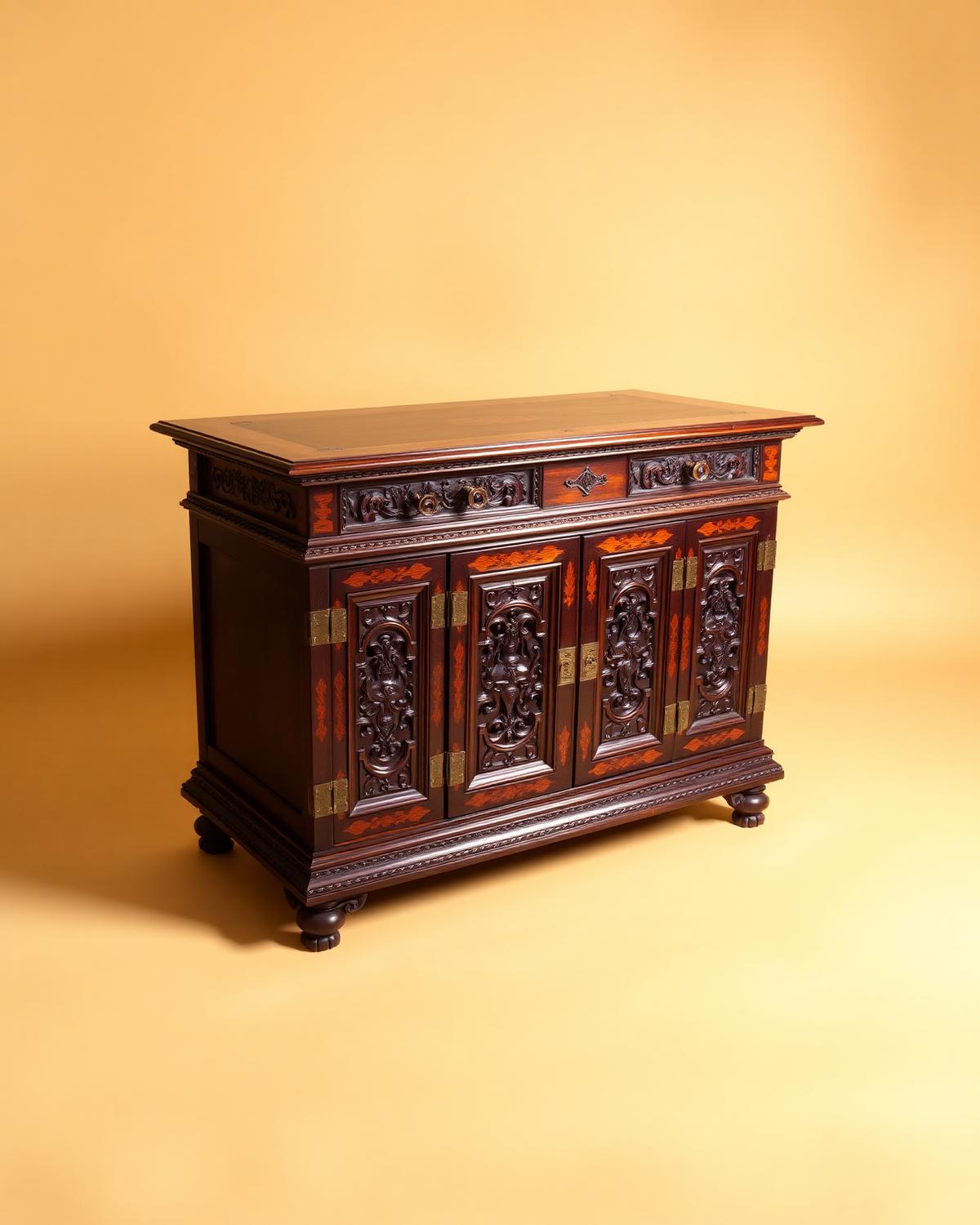
The Vinterior Deco collection typically includes a small number of cocktail cabinets, dressing tables, bureaus, occasional chairs, mirrors and lighting. Because our stock rotates, the best way to see current pieces is to visit the gallery or write to us with a brief.
Frequently Asked
Questions collectors ask.
- What is Bombay Deco?
- Bombay Deco is the Indian expression of the Art Deco movement, produced in Bombay from the 1930s to the 1940s. It combines the geometric vocabulary of European Deco with Indian timbers — teak and rosewood — and local craftsmanship.
- How do I know an Art Deco piece is original?
- Look at the veneer joins, the hardware, the underside and the carcass construction. Original pieces show hand work; reproductions do not. Vinterior issues a written statement of provenance with every piece.
- Do you sell Art Deco decorative objects as well as furniture?
- Yes — mirrors, lighting, glassware and small cabinetry from the period are regularly part of our collection.
Enquire
See these pieces in person at our Mumbai gallery.
Vinterior is at G-74 / G-75 / G-76, An Nasr, Mutton Street, Mumbai. Visits are welcomed by appointment; enquiries by WhatsApp are answered the same day.